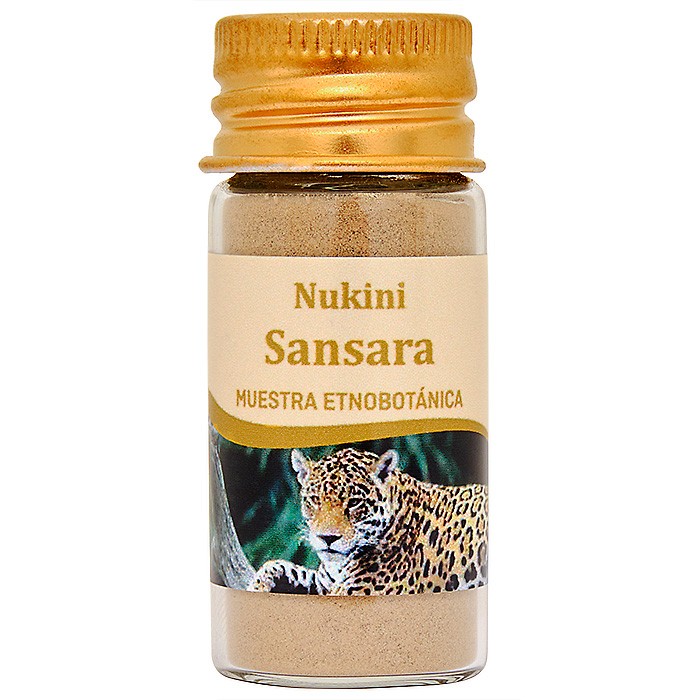
Sansara Rapé
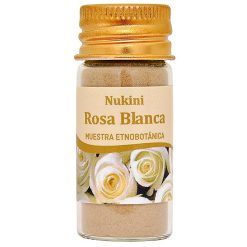
Among Nukini varieties, Sansara occupies the feminine pole alongside Rosa Blanca. Where Onça accompanies with the firmness and stillness of the jaguar, and where Rosa Blanca accompanies with a floral delicacy, Sansara offers a different quality, listening before acting.
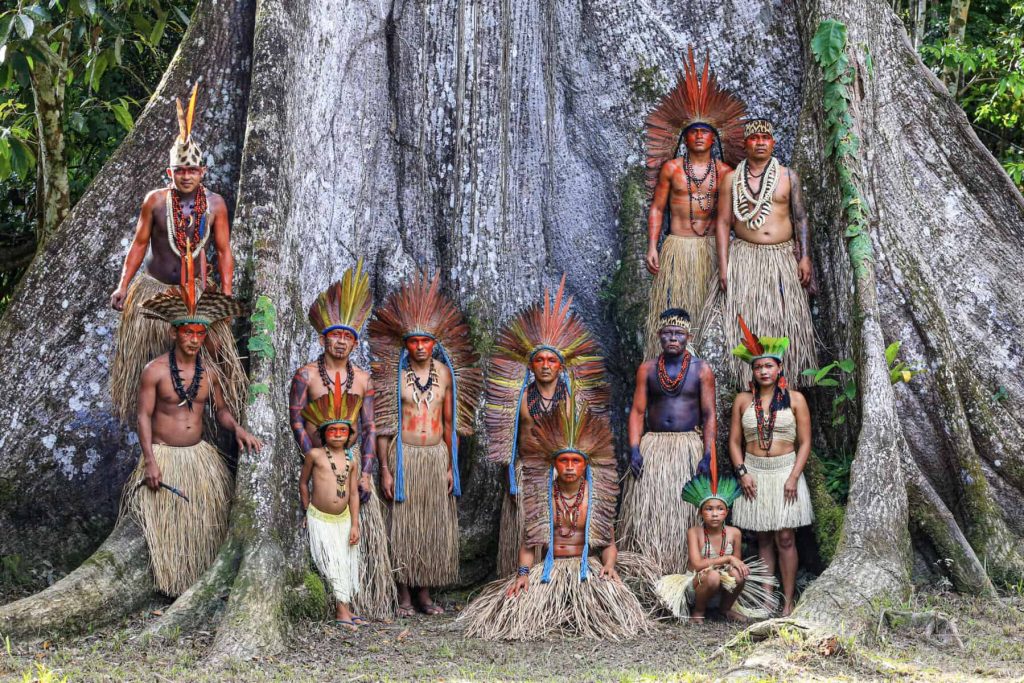
Sansara is prepared by Nukini women, heirs to a warrior tradition and to a feminine knowledge transmitted across generations. In the rapé they prepare, the two dimensions coexist: the strength of the jaguar and the listening of the women.
🌿 Variety Details
🍂 Composition:
-
Mapacho (Nicotiana rustica)
Mapacho is the base of Nukini Sansara rapé. The leaves are rolled, twisted, and undergo a fermentation process during which the plant transforms until its strength is concentrated.
-
Tsunu ash
Tsunu ash (Platycyamus regnellii) is the component that brings firmness and cohesion to the blend; its alkaline composition acts upon mapacho by releasing and enhancing its strength, accompanying it toward its fullest expression. This principle is part of an ancestral knowledge present in many traditions across the continent, where certain alkaline plant elements accompany and release the potency of the plant they work with.
-
Sansara
The Sansara herb grows in deep synchrony with its environment: its life depends on the tree that sustains it, and it can only exist within that relationship. It carries a delicate, sweet aroma and is highly valued for its cleansing properties.
🍂 Ceremonial use
Within a ceremonial approach, Sansara is especially suited to moments of cleansing and preparation, when one seeks to clear what has accumulated before entering a space of greater depth. Its cleansing character makes it akin to moments of transition, to the close of the day, or to the beginning of an inner work where clarity is a necessary condition.
Its adaptable quality allows it to accompany different contexts without losing its identity. In moments of meditation, it favours a gradual stilling; in moments of movement, it accompanies and propels.
🍂 Details:
Tribe: Nukini
Region: Alto Juruá, Acre (Brazilian Amazon)
Composition: Mapacho (Nicotiana rustica), Tsunu ash, and Sansara herb
Balance: Earth, balanced
Character: Feminine with warrior roots, adaptive and receptive
Format: 10 ml jars (approx. 8–9 g)
Use: Amazonian ethnobotanical sample
🌿 The Interconnections of the Forest
The Interconnections of the Forest
🍂 The forest as network
In the Amazonian forest, all plants grow as part of a single interconnected network; the forest is a living weave where trees, herbs, fungi, and roots sustain one another — a network that Amazonian peoples have recognised for millennia and that contemporary science is only beginning to map. Sansara can exist only within that weave, expressing the way the forest interconnects.
The Huni Kuin, a Pano family like the Nukini, call yuxin the vital force that permeates the living: an energy that passes through plants, animals, waters, and skies, binding them to one another.
The Samaúma tree — the kapok, the tallest of the forest — is for them the place where “all the spirits of the forest are united up there.” The Shipibo render it through another image: the kené, the sacred designs that adorn their bodies and their fabrics, are traces of a single weave that connected the universe at its origin.
In recent decades, the existence of mycorrhizal networks has been documented: fungi that colonise the roots of more than eighty percent of terrestrial plants and connect them beneath the soil. Through these networks, trees transfer carbon, water, and chemical signals: a mother-tree feeds its offspring, a sick tree warns its neighbours, a cut stump may remain alive for years thanks to the support of the surrounding trees. What Amazonian peoples called yuxin or kené now has, too, a fungal translation.
🍂 The Nukini, part of the weave
The Nukini recognise themselves as part of the forest, one more node in the network. The pajés, spiritual masters of the tribe, are the intermediaries between the human world and the world of the spirits: they hold a deep knowledge of medicinal plants, of songs, of rituals. Their role in the network mirrors the one that, in the plant world, is fulfilled by the Samaúma or by the mother-tree of the mycorrhizal network: they are the human node that connects, sustains, and translates.
Paulo Nukini, who was Nukini chief for twenty years, recalls that his grandfather taught him to listen to the forest and to guide his people toward harmony between themselves and the land they inhabit. The pajé listens before acting, connects to the network, and translates it for the community.