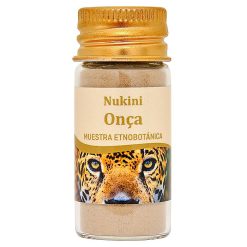
Rapé Onça
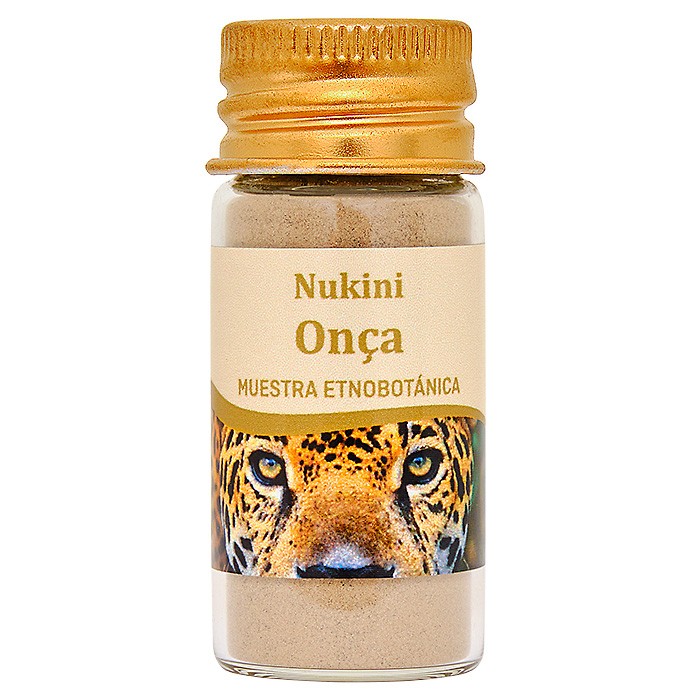
Among the varieties crafted by the Nukini people, Onça holds a unique character that integrates the qualities and spirit of the jaguar. Born from the knowledge of Chief Xiti, spiritual leader of the Recanto Verde community, this variety expresses the masculine pole of the Nukini tradition: where Rosa Blanca accompanies with delicacy, Onça accompanies with strength, focus and a profound stillness.
Among the Nukini, the preparation of rapé is a predominantly feminine practice. Onça is an exception: a medicine crafted by masculine hands, those of Chief Xiti, where the strength of mapacho, the presence of the jaguar and the intention of the one who prepares it converge in a single direction.
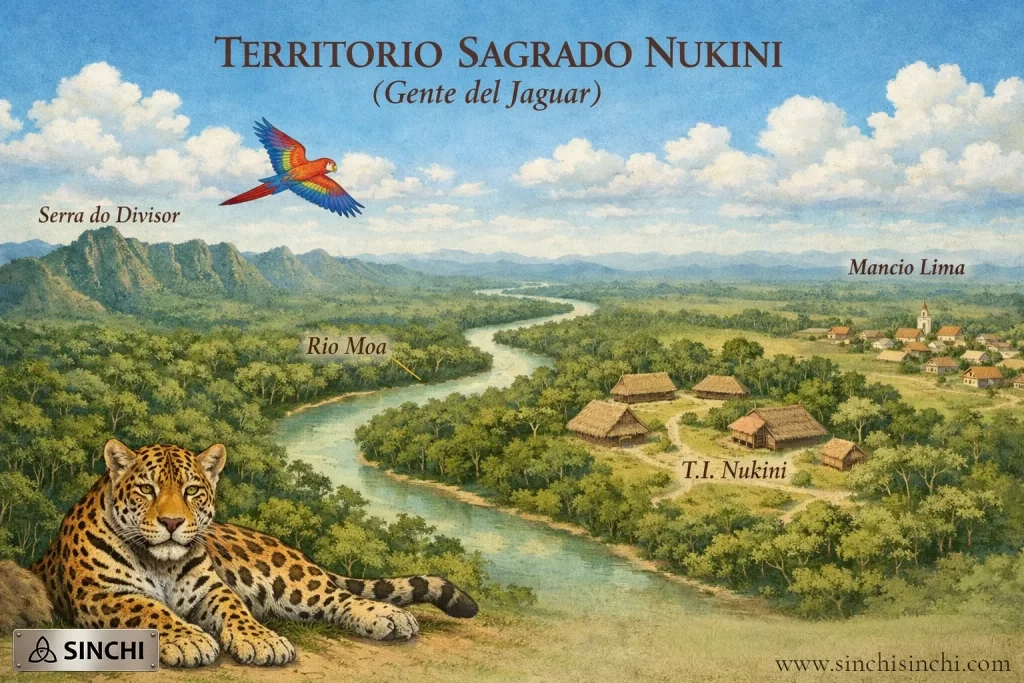
The plants that compose this medicine grow in the Serra do Divisor, one of the regions of greatest biodiversity on the planet, where species exist that are found nowhere else, and the rare native herbs that Xiti selects are part of this ecosystem.
🌿 Variety Details
🍂 Composition and tradition
-
Mapacho sabiá (Nicotiana rustica)
Mapacho sabiá is the base of Nukini Onça rapé. The mapacho leaves (Nicotiana rustica) are rolled, twisted like a rope and left to ferment for up to ninety days, during which the plant transforms: it concentrates its strength, darkens and gains density, a process understood by tradition as a deepening of the mapacho’s own character.
It is one of the most potent varieties of Amazonian mapacho, valued by the artisans of the forest for its strength and depth.
-
Tsunu ash
Tsunu ash (Platycyamus regnellii) is the component that gives firmness and cohesion to the whole. Its alkaline composition plays an active role in the medicine, releasing and potentiating the strength of the mapacho, accompanying it towards its fullest expression.
This principle forms part of an ancestral knowledge present across different traditions of the continent, where certain alkaline plant elements accompany and release the potency of the plant with which they work.
-
Secret plants of the Nukini tradition
The recipe includes a secret selection of native herbs from the Serra do Divisor ecosystem, chosen from a repertoire of plants that the Nukini have known and employed for generations.
🍂 Ceremonial use
Onça particularly accompanies moments of deep meditation, sustained concentration and inner alignment. Its character is firm and penetrating, with the strength that tradition recognises in the Jaguar, bringing focus, depth and inner balance.
Within the Nukini tradition, Onça accompanies works of spiritual protection and ancestral connection. It is a medicine that holds with firmness, with the presence that tradition recognises in the spirit of the jaguar as guardian of the forest and of the invisible thresholds.
In the Pano tradition, naming a rapé after an animal spirit is to signal that this medicine holds a direct bond with its qualities.
🍂 Details:
Tribe: Nukini
Region: Alto Juruá, Acre (Brazilian Amazonia)
Composition: Mapacho Sabiá, Tsunu ash and secret plants of the Nukini tradition.
Balance: Moderately earthy
Character: Masculine, firm and profound
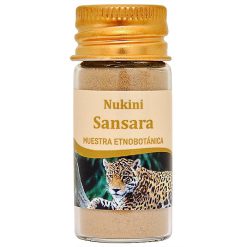
Format: 10 ml jars (approx. 8–9 g)
Use: Amazonian ethnobotanical specimen.
🌿 Nukini: The Jaguar Tribe
Nukini: The Jaguar Tribe
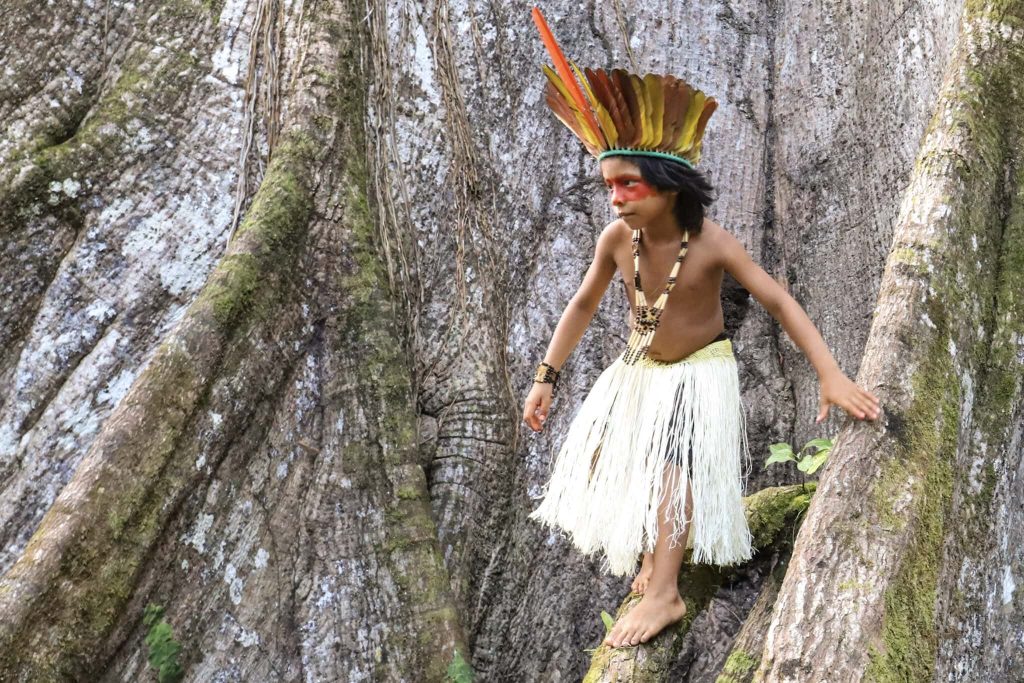
The Nukini are, by their very lineage, a people of the jaguar. One of their original clans bears the name Inubakëvu (people of the painted jaguar), and this relationship has shaped their spiritual identity for generations. For the Nukini, the jaguar is the guardian of the forest, guide on the spiritual paths and protector of those who work with the plants of medicine.
The Nukini are organised into four patrilineal clans, each linked to a being of the forest: Inubakëvu (people of the painted jaguar), Panabakëvu (people of the açaí), Itsãbakëvu (people of the patoá) and Shãnumbakëvu (people of the serpent). This ancestral bond is inherited through the paternal line and places each person in a precise position within the community. Among the four, the jaguar holds the place of guardian of the forest, and it is its strength that gives the people their name: the Nukini are the people of the Onça.
For the Nukini worldview, the jaguar, beyond being the most powerful animal of the territory, is the guardian of thresholds, the being that sees in the darkness and moves between the visible world and that of the ancestors. Its power resides in presence — a silent strength that inhabits the dense forest without seeking to show itself. For the Nukini, this quality of the jaguar is spiritual before it is biological.
In the Amazonian tradition, the initiation of the shaman passes through spiritual trials where successive forces appear — spirits that take on increasingly powerful forms. The jaguar occupies the highest threshold: only the one who holds its presence with firmness gains access to the next step. The shaman and the jaguar thus share a single spiritual teaching, and the strength of the jaguar comes to dwell in the one who has known how to sustain it.
🌿 Natural Environment of the Nukini
Natural Environment of the Nukini
The Nukini community of Recanto Verde is settled within the Serra do Divisor National Park, in the far west of Acre, along the border with Peru. It is one of the regions of greatest biodiversity on the planet: more than 843,000 hectares spanning from Amazonian lowlands to limestone mountain ranges rising above 600 metres. This diversity of elevations and environments gives rise to distinct ecological zones with species that exist only in this place.
In this territory, more than 1,200 species have been documented, and it is estimated that at least 1,000 more remain undiscovered. Birds, large mammals, amphibians and endemic insects share an ecosystem whose greatest protection has been, for centuries, its own remoteness.
The jaguar is one of the most admired presences of this landscape — solitary, a powerful swimmer, capable of remaining invisible for weeks in the dense forest — and its presence is sensed more than it is seen. The communities that inhabit the park know its routes, its tracks along the rivers, and its way of crossing the territory without being seen; its manner of inhabiting the forest is that of a strength that moves in silence.
Today, the Serra do Divisor faces the threat of a road project, the pressure of illegal loggers and the expansion of cattle ranching. The plants that Xiti selects for his medicines are born of this ecosystem, and their continuity remains tied to the protection of the territory.