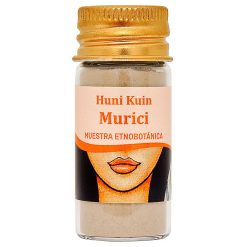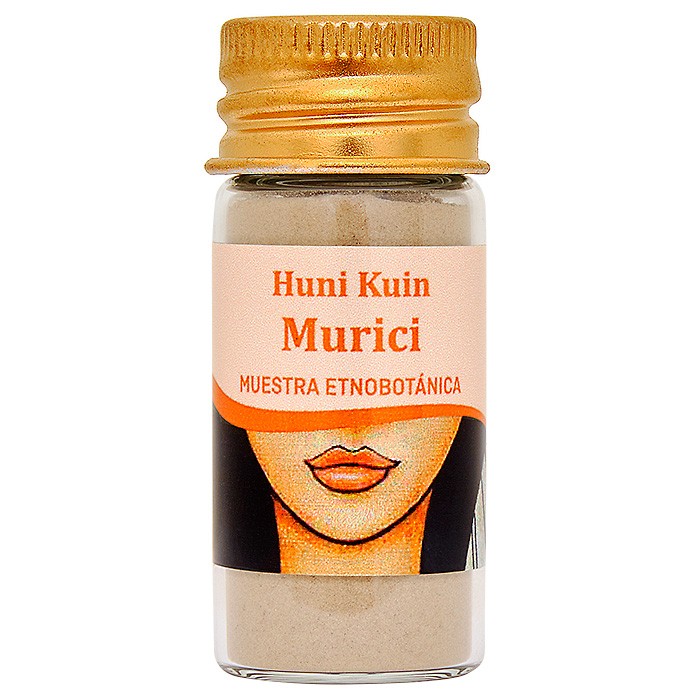
Rapé Murici
Huni Kuin Murici rapé is prepared with Amazonian mapacho (dume) and ash from the bark of the murici tree, very light and fine, characterized by a remarkably soft and luminous quality, with properties that tradition associates with vitality, joy and readiness for action.
Murici accompanies moments of work, celebration, community gatherings, active meditation and concentration in everyday tasks.
The Huni Kuin people distinguish two spheres of medicine: dau bata (sweet medicine), which belongs to the huni dauya (herbalist), and dau muka (bitter medicine), which belongs to the mukaya (shaman).
Within the Huni Kuin cosmovision, Murici belongs to the sphere of dau bata (sweet medicine). Dau bata accompanies the visible and everyday life; it is medicine that strengthens the body without interrupting the routine. This character distinguishes it from the opposite pole, dau muka (bitter medicine), reserved for the mukaya (shaman) and ceremonies of greater spiritual depth.
The herbalist works with leaves, bark, animal secrets and knowledge of the visible forest; his knowledge is learned, transmitted and shared openly.
Among the great trees of the Huni Kuin cosmovision, each one has its own place. The cumaru (kumã) is the tree that never rots, the most truthful, linked to permanence and shamanic power. Tsunu is associated with concentration and deep spiritual work. The mulateiro sheds its bark as the anaconda sheds its skin, linked to renewal and cleansing.
Murici has the quality of being ever present, its story is one of everyday presence: the tree whose fruit is eaten, whose wood warms, whose bark heals and whose ash accompanies the rapé. It is a tree that belongs to the realm of the everyday, always accessible, present in the immediate surroundings of the community.
Curiously, the murici and the caapi (ayahuasca) belong to the same plant family, the Malpighiaceae. Two paths within a single plant family: one sweet, everyday, shared; the other bitter, ceremonial, reserved.
The Ash of Murici
In Hãtxa Kuĩ, the tree ash that accompanies mapacho is called mapu, and each variety of rapé takes the name of the tree that provides it. Murici ash is obtained from the bark of the tree, carefully harvested, sun-dried and slowly burned over low heat for hours until it is reduced to a light and extraordinarily fine powder.
The bark of the murici is rich in minerals that become concentrated during burning: when fire transforms plant matter into ash, what remains is an alkaline powder, dense in calcium and potassium, that awakens the strength of the mapacho and accompanies it to its fullest expression.
This alkaline principle is the same found in other traditions across the continent where ash or plant-based limes release the potency of the plant they work with.
Among the four main ashes of Huni Kuin rapé, murici ash is the lightest and finest: an almost white powder, soft to the touch, that contrasts with the darker and denser ashes of tsunu or cumaru. This lightness defines the character of Murici as a variety: an open, luminous rapé, traditionally oriented towards daily use.
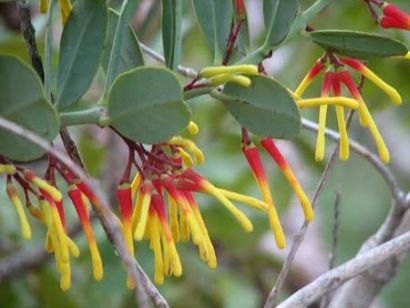
The Murici Tree 🌳
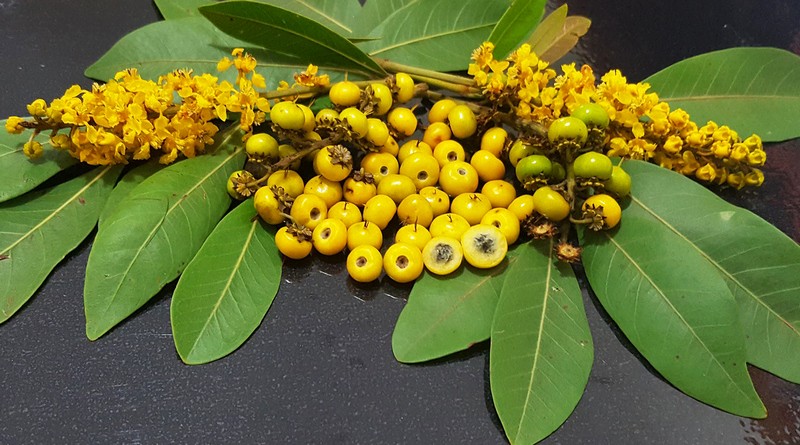
The Murici (Byrsonima crassifolia), yapa in Hãtxa Kuĩ, bears a sweet, round, yellow-orange, intensely aromatic fruit.
It is a small tree with a broad and irregular crown, rarely exceeding eight metres in open forest. Its leaves are thick, dark green and glossy on the upper surface, covered on the underside with a rust-coloured velvet that is very soft to the touch. The young branches share the same reddish-brown tone.
The bark is thick, deeply fissured, greyish-brown and darkening with age. It is dense, compact, rich in tannins, and is the part of the tree harvested to produce the rapé ash. When burned over low heat, this bark produces long-lasting embers and an extraordinarily fine ash of a light grey, almost white colour.
During the flowering season, the Murici transforms. Clusters of yellow flowers burst from the tips of every branch like small torches. As the flowers mature, their petals turn from yellow to orange and from orange to red, so that a single cluster displays all three colours simultaneously: a gradient of living fire on each spike.
The flowers of the murici, rather than producing nectar like most flowering plants, produce oil: specialized structures at the base of the sepals, called elaiophores, secrete a dense oil that is collected by specialized bees of the genus Centris. These bees grasp the petal with their mandibles, scrape the elaiophores with their legs to release the oil and transport it to the nest, where they use it to build cells and feed their larvae.
It is a relationship of mutual dependence: the murici needs the Centris bees to reproduce, and the bees use its oil to raise their offspring.
The fruit is a small, round drupe of just one or two centimetres, ripening from green to intense yellow and finally to orange. The pulp is white, juicy and oily, with a penetrating and unmistakable aroma that blends the sweet with the fermented. It is an aroma that permeates: a tree with ripe fruit on the ground can be detected from a distance.
The flavour is tart, with a certain oily taste that divides opinions and wins over those who grow up with it. The fruit is eaten raw, fermented to produce chicha and distilled into liqueur in Mexico and Central America.
The Murici is a tree of fire. In the Brazilian cerrado, where periodic burns are part of the natural cycle, the murici has developed three forms of resistance: a thick bark that insulates its interior from the flames, an underground woody organ (xylopodium) that survives beneath the soil and sends out new shoots after the fire, and a great capacity to colonize burned ground.
The Murici is a pioneer species: it grows in impoverished, burned or abandoned soils where other trees cannot yet establish themselves. Its roots form alliances with mycorrhizal fungi that extract phosphorus from deep soil layers, and its abundant leaf fall returns to the ground the minerals (calcium, potassium, manganese) that the next generation of trees will need to grow.
The bark of this very same restorative tree is the one that, when burned, produces the ash of Murici rapé: it is the ash of a tree that heals the earth. The minerals that the Murici draws from the depths of the earth and accumulates in its bark are the same that become concentrated in the ash and accompany the mapacho.
The Murici Tree in Mesoamerica
The Murici tree grows from central Mexico to Bolivia. In Mesoamerican traditions, this same tree goes by the name of nance, nancite or craboo, and its presence extends throughout the Maya, Nahua and Caribbean world.
In Nahuatl, the language of the Mexica, the murici is called nantzinxocotl: nantzin (mother, lady, with the reverential suffix -tzin) and xocotl (fruit). The suffix -tzin is the same that appears in Tonantzin (“Our Revered Mother”), reserved in Nahuatl for entities of high spiritual standing. In Yucatec Maya, the murici tree is called chi’.
Spanish colonial sources document that the Yucatec Maya of the sixteenth and seventeenth centuries used nance leaves to wrap their mapacho cigars. This detail, recorded by researcher Nicholas Hellmuth from colonial chronicles, establishes a direct link between the murici and mapacho in the Maya tradition: the same tree that in the Amazon accompanies mapacho as ash, in the Maya world accompanied it as wrapping.
The nance also appears in the Popol Vuh, the sacred book of the K’iche’ people, as one of the fruit trees in the mythical surroundings of the Hero Twins. Its sweet and aromatic fruit is fermented in Guatemala to produce chicha de nance, a traditional drink of communal celebration that requires up to six months of fermentation. In Costa Rica it is distilled as crema de nance, in Mexico as licor de nanche: the Murici is a tree that in every tradition accompanies the gathering, the celebration and what is shared.
The Murici Tree in Brazil
In Brazil, in the state of Acre, at least six indigenous peoples from three distinct linguistic families work with its ash in the preparation of rapé: the Huni Kuin, the Yawanawá, the Katukina, the Shawãdawa, the Shanenawa (all from the Pano family) and the Puyanawa.
The Kulina (Arawá linguistic family, distinct from the Pano) also use murici ash. For the Puyanawa, murici is the main ash of their rapé tradition, sometimes the only one they employ.
In the north of the Amazon, on the savannas of Roraima, the Makuxi (Carib family) know the murici as mirixi vermelho.
The Amazonian Huni Kuin Tribe
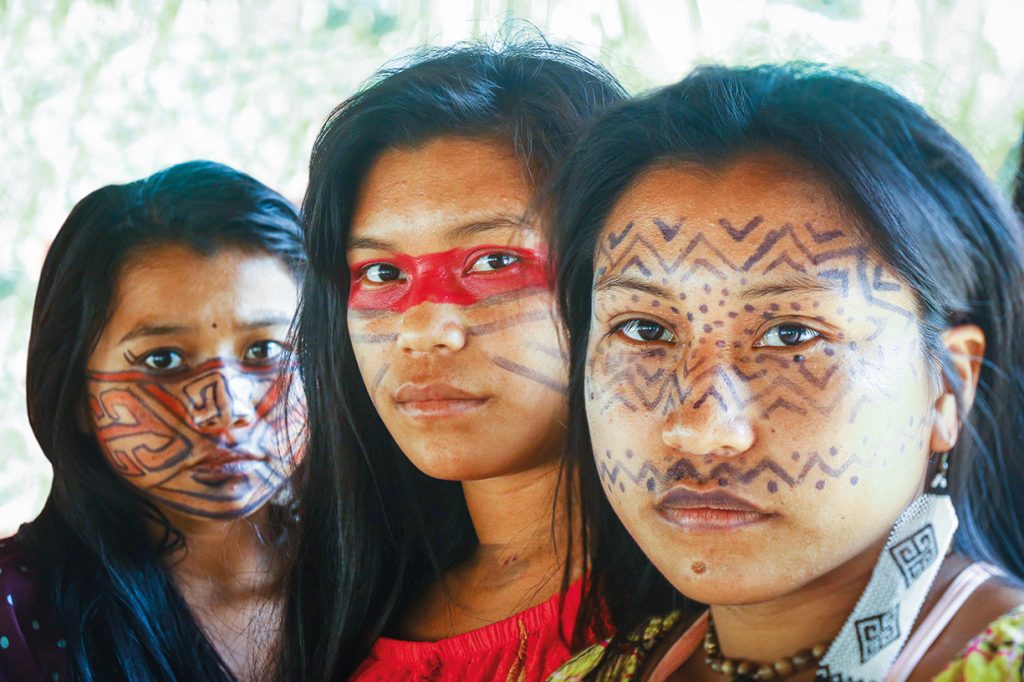
The Huni Kuin are one of the most numerous and culturally vibrant indigenous peoples of the Brazilian Amazon. Their name means “the true people” in Hãtxa Kuĩ, their language, which belongs to the Pano family. They inhabit the basins of the Jordão, Tarauacá, Envira, Murú, Humaitá and Purus rivers, in the state of Acre, with a population exceeding fifteen thousand people spread across more than one hundred villages.