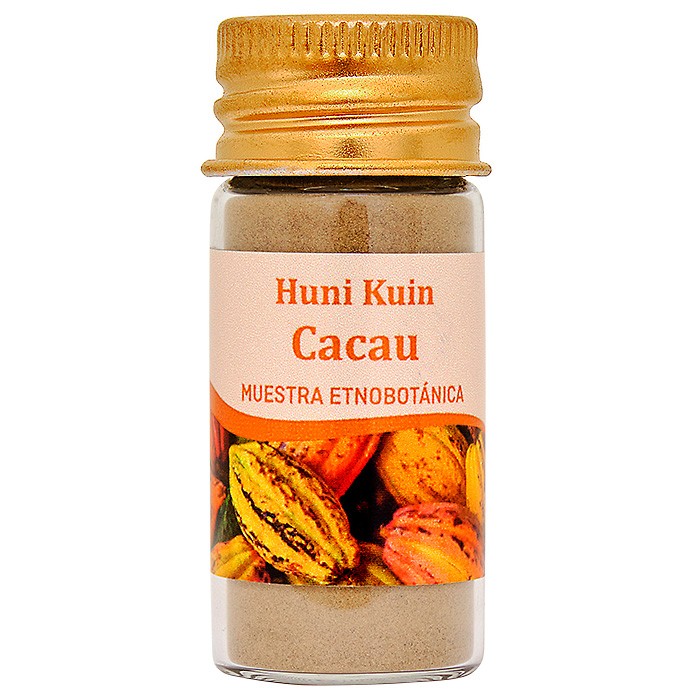
Rapé Cacao
Cacao rapé is made with ash from wild Amazonian cacao, a tree that the Huni Kuin people call “txashu reshã” in their language, Hãtxa Kuĩ. The wild cacao grows along the riverbanks of the territory, where the firm land meets the water.
From the bark of this ancestral tree they obtain a reddish ash that is blended with a high proportion of mapacho Sabia to produce this variety, one of the strongest in the Huni Kuin tradition.
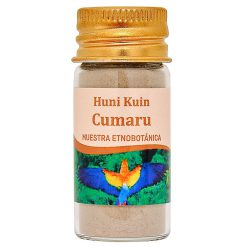
Cacao has a warm, intense and cleansing character. Where Murici accompanies the daily routine with lightness and Cumaru supports spiritual work with steadfastness, Cacao acts with an enveloping warmth that clears and grounds, accompanying moments that call for cleansing, strengthening and presence.
The Huni Kuin harvest the bark of the wild cacao, clean it, dry it, cure it and burn it for hours following the ancestral method until it becomes a fine ash of reddish colour. What remains after the fire is mineral: potassium, calcium, phosphorus. The ash alkalises the rapé, raises its pH and awakens the strength of the mapacho with a warmth that makes this variety unique.
The plant ash raises the pH of the blend from an acidic range to an alkaline one, and this change converts the nicotine in the mapacho to its free-base form, multiplying its availability. It is the same principle at work in the leaf preparations of the Andes, or in Amazonian mambe.
- Composition: Amazonian mapacho Sabia and wild cacao bark ash.
- Balance: Extra strong (little ash, high proportion of mapacho)
- Use: Amazonian ethnobotanical sample
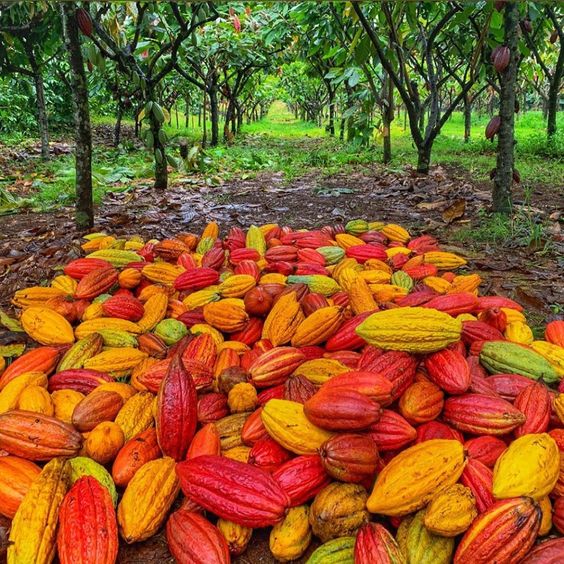
The Cacao Tree
Cacao grows wild along the riverbanks of the Huni Kuin territory. It is a tree of the riparian forest, of the boundary between firm land and water, of the banks that flood and recede with the pulse of the river.
It is an understorey tree: rather than seeking sunlight, it prefers the shade that larger trees offer. In fact, within Amazonian forest systems, one of the trees that shelters it is known as the “mother of cacao”.
It reaches twelve to fifteen metres in the wild, modest compared to the giants of the canopy, and drives a taproot up to two metres deep — unusual for a tree that grows in the shade of others. This root allows the cacao to withstand the seasonal river floods for months, producing new roots from the stem when the water rises.
Its flowers emerge directly from the trunk and old branches, small, pinkish, almost invisible against the bark. They are pollinated by tiny midges that breed in the leaf litter at the foot of the tree itself: it needs the leaves it drops in order to keep bearing fruit.
The tambaqui are large freshwater fish that eat the pulp of fruits that fall into the water, among them cacao, and disperse the seeds up to five kilometres downstream, planting cacao along the riverbank.
Origin of cacao
In 1753, Linnaeus named cacao Theobroma: food of the gods. He did so thinking of the Maya and Aztec temples, of their chocolate drinks reserved for kings and priests. The name travelled the world linked to Mesoamerica, and with it travelled the idea that cacao belonged to those lands.
But cacao was born in the Amazon, long before Mesoamerica ever knew it.
The cacao seed travelled from the Amazon to Mesoamerica, where the Olmecs, the Maya and the Aztecs fermented it, roasted it, ground it and turned it into a drink of the gods and a currency of empires. From there it passed to Europe, where it became chocolate.
In the upper basin of the Ecuadorian Amazon, a team of researchers found cacao remains in ceramics over five thousand years old: starch grains, theobromine residues and ancient DNA. It is the earliest documented use on the continent, predating any Mesoamerican evidence by at least fifteen hundred years. A few hundred kilometres away, in Jaén (Peru), the temple of Huaca Montegrande (one of the oldest in the Americas, some six thousand years old) bears cacao motifs carved into every one of its objects; the Upper Amazon revered the use of cacao.
Of the ten genetic lineages of Theobroma cacao recognised worldwide, one bears the name of the river that crosses Huni Kuin territory: the Purus cluster. This lineage has its centre of diversity in Acre, where the species survived and preserved its highest levels of genetic variation. The wild cacao of the Purus grows today along the riverbanks, where the communities of the Huni Kuin people find it.
In 2024, three new species of the genus Theobroma appeared, the first in over sixty years. One of them, Theobroma globosum, was collected in Acre, in the Purus basin and near the Praia do Carapanã Indigenous Reserve, next to Huni Kuin territory.
Cacao in Amazonian cosmovisions
The Awajún of the upper Peruvian Amazon revere Nugkui, the feminine spirit of Mother Earth, who emerged from the depths to teach women to cultivate the plants of the forest, among them cacao. Nugkui is mistress of the earth and of everything that grows beneath it.
The region where the Awajún live (the province of Jaén, in northern Peru) is the same where Huaca Montegrande stands, the six-thousand-year-old temple whose objects bear carved cacao motifs.
Nugkui is feminine. The txashu reshã belongs to the Banu sector, the feminine lineage of Huni Kuin ethnobotany. The Awajún women are the cultivators of cacao. The Huni Kuin women receive an infusion of cacao bark during childbirth. A thread runs through the Amazon from north to south: cacao is, in the traditions of the peoples who live alongside it, a plant linked to the feminine, to the earth and to the fertility of the forest.
In the Huni Kuin cosmovision, all living beings possess yuxin: a life force that constitutes life itself. The three places of greatest concentration of yuxin are the riverbanks, the great trees and the crossroads of paths in the forest. The wild cacao is a riparian tree: it dwells exactly where two of those three zones converge.
To burn its bark and receive its ash is to work with the spirit of a tree that grows where the density of yuxin is at its highest.
The Amazonian Huni Kuin Tribe
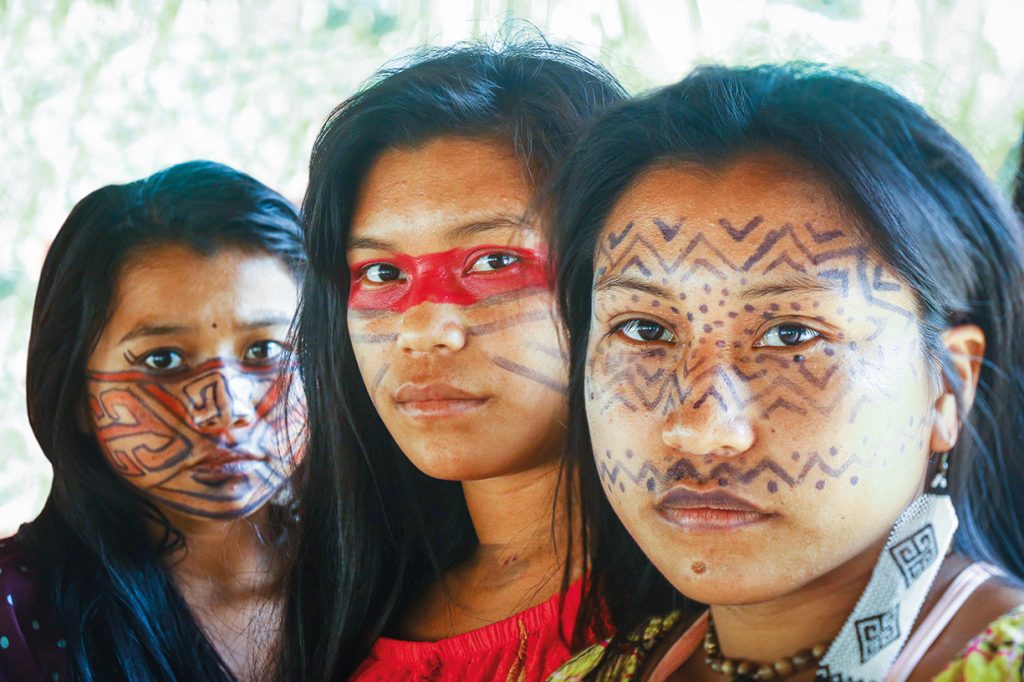
The Huni Kuin (“the true people” in Hãtxa Kuĩ, their language) are one of the most numerous indigenous peoples of the Brazilian Amazon. More than fifteen thousand people inhabit the basins of the Jordão River and the Upper Juruá, in the state of Acre, organised in over one hundred villages. Their recent history is a story of reconstruction: decimated during the rubber boom at the beginning of the twentieth century, they reclaimed their territory, recovered their language and rebuilt their communities in just three generations.